

Training & Executive Coaching
for Organisations
Strategic Planning
Change is inevitable. But it doesn't need to be chaotic.
I've conducted countless strategic planning sessions that result in co-designed documented Strategic Plans for managing change, seeking new direction, getting back on track and ending chaotic disorganisation. Delivering in Darwin and across the Territory and Australia by arrangement.
Organisations like No More and The Women's Innovation Network NT benefitted from everyone having their say, multiple options being presented and a consensus being reached.
Digital Marketing & The Web
Understanding marketing in today's online world.
No one got into business to do marketing. But it's a neccessary part of the game. Likewise, a lot of us find ourselves doing marketing as part of our multi-disciplinary roles and we're finding the whole online world a little overwhelming.
I have guided over 2000 small businesses through marketing online since 2017 through Business Station and Business Enterprise Centre NT.
I've trained staff from Matt Wright Adventures, Charlies of Darwin, Ocean Buyers Agency, Perth Speech Therapy and even government agencies in the Northern Territory and New South Wales.
Design Thinking
When you want new revenue sources or to produce new products.
Design Thinking is one of those really annoying academic concepts that no one really uses because it's full of jargon that no one understands.
My Design Thinking workshops break down the mess and make it fun and effective for teams looking to build new products, design new services or come up with new ideas for revenue.
I've taught it at Charles Darwin University and Central Queensland University. And I've helped the teams at Darwin Innovation Hub, Catholic Care and City of Darwin get their design thinking breakthroughs.
LinkedIn & Thought Leadership
Leaders are surfaced, discovered and created on LinkedIn.
Organisations can't ignore LinkedIn. Especially when 16 million Aussies are active on it - and they are doing business, finding jobs and unskilling in a time when skills are hard to find and very in-demand.
However, few organisations have a LinkedIn strategy and their executives aren't active on the world's biggest professional platform.
But they are waking up to the opportunity and LinkedIn use has skyrocketed in the last few years.
I was awarded a LinkedIn Top Voice status in 2024: only 300 are awarded globally each year.
I provide training and executive coaching on how to work with LinkedIn for individuals and organisations using a tested and provdem method.
Entrepreneurship
We're all part of the sales and innovation departments these days.
Even if we are not business owners, there's value in employees learning about entrepreneurial thinking.
It's not necessarily about starting businesses. Entrepreneurship helps your team thinking from the point of view beyond just their own role - and to the bigger picture of how organisations operate, and how thinking beyond the routine and set processes can transform an organisation from stagnant to dynamic.
My entrepreneurship workshops are based on both experiences as a serial entrepreneur, my studies with University of NSW in Marketing and Business Information Systems as well as the principles in the curricula that I've taught at Charles Darwin University, Central Queensland University and the Australian Catholic University.
The workshops are highly interactive and practical.
Social Media for Business
It's changed the way we communicate forever - especially in business.
If you're a business without an online presence, you're not in business. However, business treats social media like it's a television or radio ad.
In this comprehensive full-day program, your team will learn about the platforms, the purpose, the best practices, the fine line between brand values and the attention economy as well as forming a content plan for your business that will not only reach your target customer, but lead them to engagement.
Speaking with Confidence
Confidence isn't born, it's learned.
The power of public speaking can be used to inspire, move and transform teams. But even at the smallest level, it brings the confidence to speak up in meetings, contribute to team work and collaborate with others. Simply, public speaking is less about TEDtalks and more about everyday use of our voices and our thoughts.
This is what Study NT Student Ambassadors, NT Training Awards Participants, Airport Development Group and Real Estate Institute of the Northern Territory learned when they used this training.
AI Literacy
Using AI safely, privately and effectively in 2025.
Your staff are already using ChatGPT. Even if they've been told not to. So you could try and. "policy your way out of it" or you could provide the tools and training for them to use it safely and more effectively.
My half-day and full-day AI tools training introduces your team to not only the tools, but to how to best use them to get real work done in a privacy-first and safe way.
You'll learn how to integrate AI into your workflows so that everyone works better, faster and more accurately without compromising data privacy and business confidentiality.
Specialist Training for Government
Things in government are a little different to the private sector.
I have been delivering Digital Skills, AI Literacy, Strategic Planning, Design Thinking, Social Media and Crisis Communications training for the public sector for years now through local councils like Coomalie Community Council, West Arnhem Regional Council, Trade & Investmetn Queenland, NSW Health, WA Small Business Development Corporation, Northern Territory and Queensland Governments, Austrade and Ausindustry.
I am also a contracted trainer for the Public Sector Network across all three levels of government in Australia and both levels in New Zealand.
All my training programs are available and contextualised for both your government and local application.
Latest from The Saturday Sprint
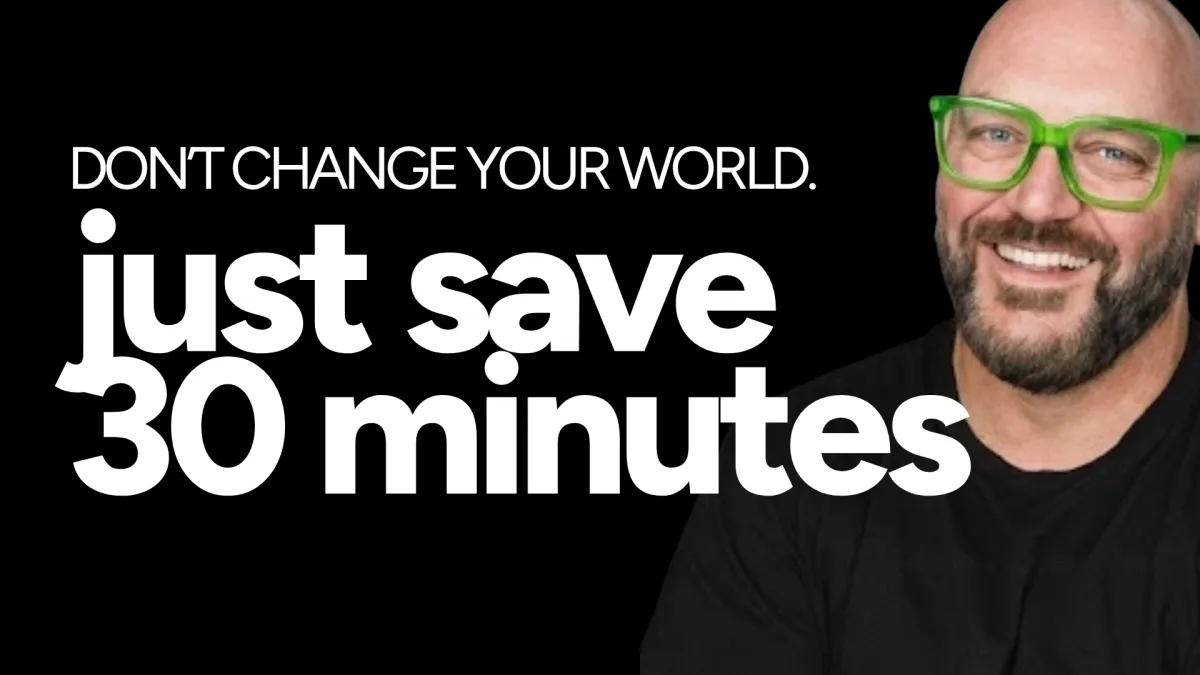
Your first AI win needs to save you 30 minutes, not change your life
There is a bloke on YouTube — American accent, ring light, probably a baseball cap worn backwards — telling you that AI will replace your nine-to-five, print $50,000 a month while you sleep, and free you to work two hours a week from a hammock in Bali. He has 400,000 subscribers. His thumbnail is a photo of him standing next to a car he rented for the day.
And somewhere in regional Western Australia, or in Darwin, or in a small business in Geraldton that has been operating for eleven years on spreadsheets and stubbornness, someone is watching that video at 11pm and thinking: this time. This is it.
I want to be kind about this, because I genuinely am not here to mock anyone. But I also want to be honest. And the honest version of this story is that the people most excited about automating their entire lives with AI tools they've never touched are frequently the same people who had a garage full of Herbalife product in 2004, who moved serious money into Dogecoin in 2021, and who spent a solid six months trying to dropship children's clothing from Guangzhou before the margins ate them alive. Same energy. Same dream. Different branding.
The thing is, AI is actually useful. Genuinely, practically useful in ways that those other bets weren't. But not if you approach it the same way.
The gap between where you are and where you want to be
Most small business owners I talk to haven't spent two hours inside ChatGPT. Some haven't opened it at all. They've heard about it, maybe read a few headlines, possibly watched that YouTube video. But they haven't sat down and asked it a single question relevant to their actual business.
Yet they want to talk about agents. Automation stacks. Replacing their staff. Building passive income systems that run without them.
That gap — between never having used the tool and wanting to build a life around it — is not ambition. It is avoidance. It is the same psychological move people have been making with every shiny new thing for thirty years. If I can just get the big win without doing the boring work, then I don't have to confront the boring work.
AI doesn't work like that. Nothing does, but especially not this.
What a real first win looks like
A BDM I work with has one of those split roles that exist because small businesses can't justify hiring three people, so they hire one person and give them three jobs. Her title includes business development, but she also owns the company website articles and the social media content. She's sharp, she's good with people, she closes deals. Writing content, though, is not her thing. Not because she lacks intelligence — she has plenty — but because it genuinely does not interest her, and the work she produces reflects that. She'd spend two hours on a blog post and still feel like it wasn't right. Then she'd leave it in drafts for a week. Then post something mediocre and feel vaguely terrible about it.
She is not unusual. This is most people in her situation.
When she finally sat down with ChatGPT and spent twenty minutes learning how to brief it properly, she got a decent first draft of a 600-word article in about four minutes. She spent another fifteen minutes editing it into her voice and checking the facts. Total time: under thirty minutes, instead of two hours and a simmering low-grade dread. The output was better. She was less miserable. She moved on with her day.
That is an AI win. It is not glamorous. Nobody is making a YouTube video about it with a rented Ferrari in the thumbnail. But it is real, it saved her time every single week, and it built her enough confidence to find the next thing she could improve.
Small wins compound. Skipped steps don't.
Here is what I have watched happen with people who chase the big automation dream before they understand the basics. They spend $200 on a course. They sign up for three tools they don't understand. They build a half-finished workflow that breaks because they skipped the part where you learn what the tool actually does. They get frustrated, declare that AI is overhyped, and go back to doing everything manually. Six months later, the next shiny thing arrives.
Compare that to someone who spends a week just asking ChatGPT questions they'd normally Google. Supplier comparisons. Draft emails to difficult clients. How to word a quote for a job in Karratha when they've never done that kind of project before. They start to understand what the tool is good at and, just as importantly, where it goes sideways. That knowledge is worth more than any course, because it comes from their actual work.
Then they find the next thirty-minute win. Then the next. By month three, they've quietly reclaimed five or six hours a week without blowing up their systems or betting their business on a tool they don't understand.
The boring path is the fast path. It just doesn't feel like it from the outside.
When this advice doesn't apply
If you already use AI tools regularly, this isn't for you. If you've been inside these platforms long enough to understand their limits and you're genuinely ready to build more complex systems, go for it. There are real and significant business advantages available to people who know what they're doing.
This is also not a warning against ever thinking bigger. The goal, eventually, is to string those small wins together into something that genuinely frees up your time. That is a legitimate outcome and it is achievable. I've seen it happen for people running trades businesses in Albany, marketing agencies in Darwin, and one-woman bookkeeping operations in Broome.
But they all started with something small. Every single one of them.
The question worth asking this week
Not "how do I automate my business?" Not "how do I build a passive income system?" Just this: what is one thing I do every week that takes longer than it should, that I slightly dread, and that is mostly words?
That is your starting point. Take it to ChatGPT. Give it context. Tell it what you need. See what comes back. Edit it. Use it. Notice how it feels to have that time back.
Then find the next one.
That is the actual entry point into AI for your business. Thirty minutes saved on something that used to cost you two hours. Not a revolution. A result. And in my experience, results are the only thing that keeps people going long enough to get to the good stuff.
If you want a straightforward, no-hype look at how small business owners are actually using AI to save time right now, my newsletter covers it most weeks with specific examples and tools. Subscribe at this link.



Australian Digital Education & Retail Group Pty Ltd
ACN: 683428882
PO Box 36078 Winnellie NT 0820 Australia
Messsage Service: +61 440 137 779